

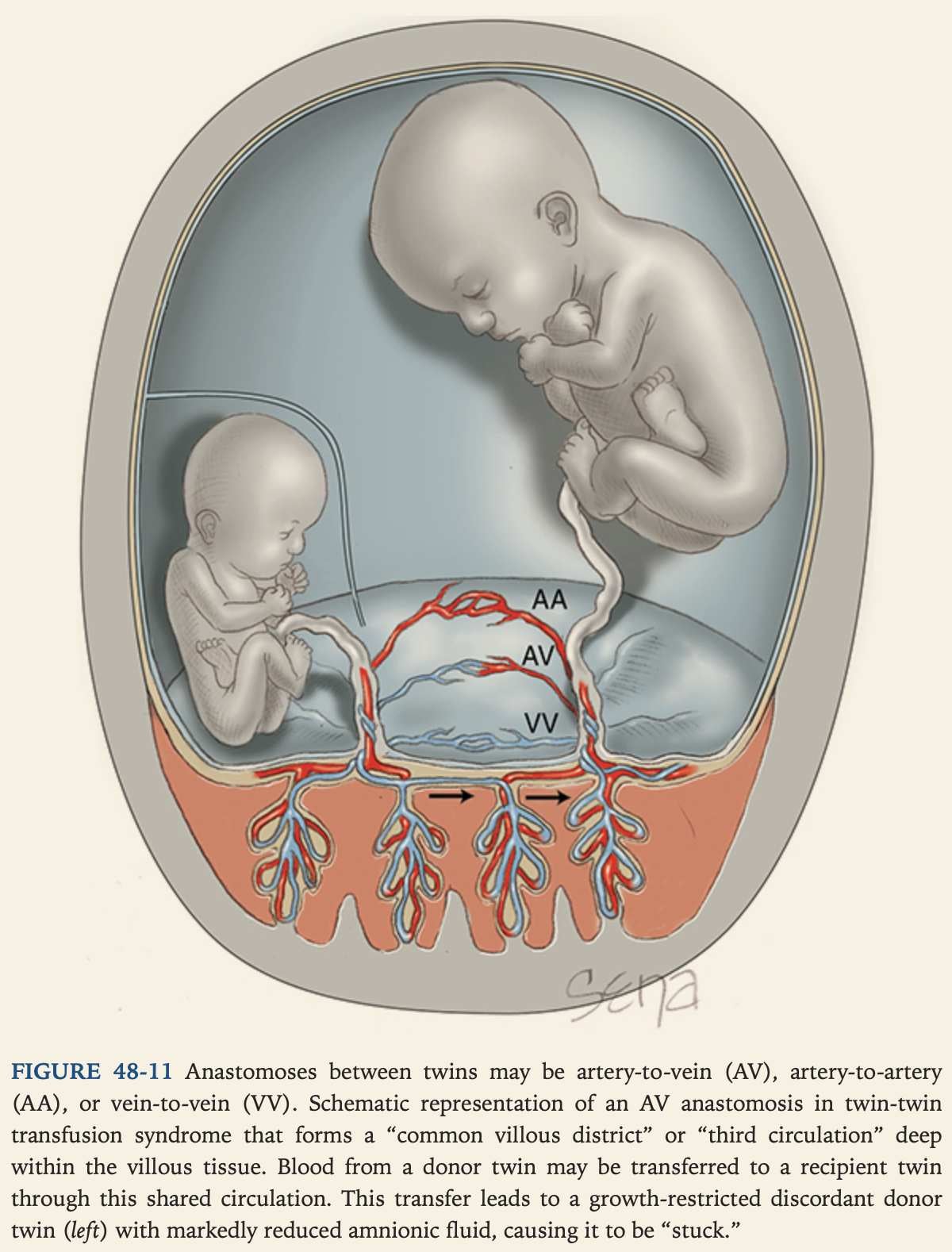
導致雙胞胎輸血症(Twin-Twin Transfusion Syndrome, TTTS)的最主要胎盤血管異常為:
In contrast to these superficial connections, deep artery-to-vein communications can extend through the capillary bed of a given villus (Fig. 48-11). These deep arteriovenous anastomoses create a common villous compartment or “third circulation” that has been identified in approximately half of monochorionic twin placentas.
**簡單來說最主要就是AV anastomosis
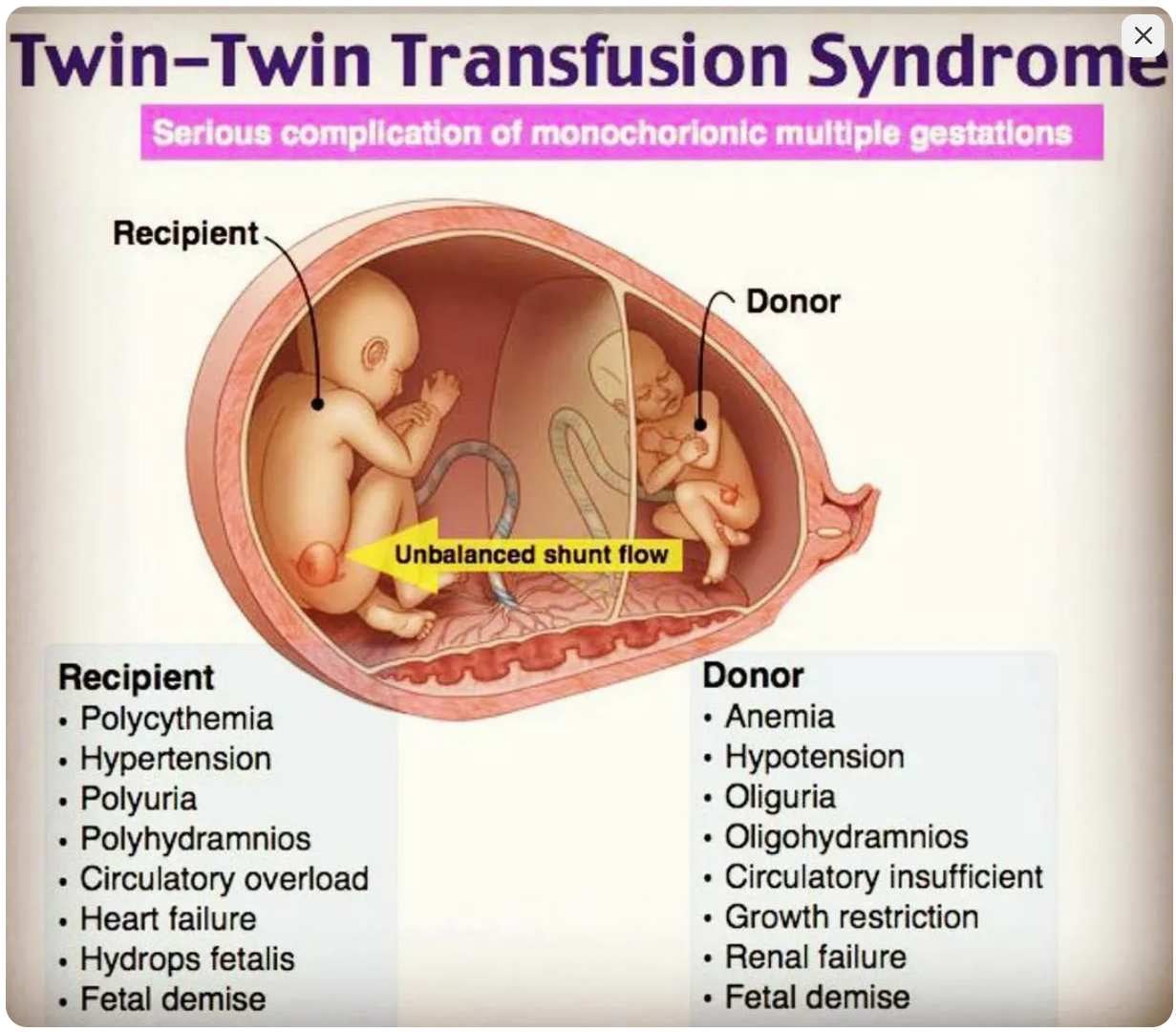
雙胞胎間輸血症候群Twin-to-twin transfusion syndrome(TTTS)
Recipient受贈者Complications
Donor捐贈者Complications
- Oligohydramnios (捐贈者) 最小垂直徑: <2 cm
- Polyhydramnios (受贈者) 受贈者羊水最大垂直徑: <孕期20週: >8公分;>孕期20週: >10公分
It is generally performed between 16 and 26 weeks’ gestation for monochorionic-diamnionic twin pregnancies with stage II to stage IV TTTS.
5 stages of TTTS based on ultrasound findings:
Stage I: This is the initial way that TTTS is seen on ultrasound. ?In stage I, there is oligohydramnios in the donor’s sac with an MVP of ?2 centimeters or less (3/4 inch) and polyhydramnios in the recipient’s sac with a maximum vertical pocket of fluid of 8 centimeters or more (just over 3 inches). ?The bladder of the donor baby is still seen.
Stage II: As defined above, there is polyhydramnios and oligohydramnios but the bladder is no longer seen in the donor twin during the ultrasound evaluation.
Stage III: Blood flow in the fetus can be measured with a special type of ultrasound called Doppler. ?In addition to the findings of Stages I and II, careful study of the blood flow in the umbilical cord and fetal ductus venosus (the large blood vessel in the fetus that returns blood to the heart from the placenta) reveals abnormal patterns in these patterns can occur in either or both fetuses.? In the umbilical cord, the diastolic flow can be either absent or reversed in the umbilical artery. ?This pattern is usually seen in the donor twin.? In the ductus venosus, the diastolic flow can either be absent or reversed. ?This pattern is usually see in the recipient twin due to early heart failure. ?The recipient twin can also exhibit leakage across the main valve on the right side of the heart – this is known as tricuspid regurgitation.
Stage IV: One or both babies shows signs of hydrops. This means there is excess fluid in ?parts of the baby such as swelling of the skin around the head (scalp edema), fluid in the abdomen (ascites), fluid around the lungs (pleural effusions) or fluid around the heart (pericardial effusion). These findings are evidence of heart failure and are typically seen in the recipient twin.
Stage V: One or both babies have died.
補充complications:
會搜尋相似的詳解進行概念對比,仍在測試中。
還沒有用戶分享的詳解
登入後可用筆記工具撰寫並公開分享你的詳解。
留言(0)